
Why Early Education Matters: Small Moments, Big Foundations
The moments that shape a child’s future often look unremarkable — until you know what to look for.
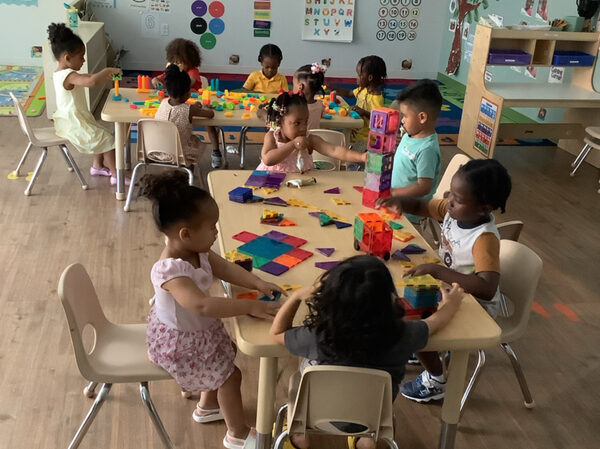
Hero image suggestion: A small child concentrating on stacking blocks, with a teacher nearby observing (not interfering). Natural light, warm classroom setting.
Caption: What looks like play is actually a child building persistence, problem-solving, and confidence — one block at a time.
The Moment You Might Miss
Your daughter spends fifteen minutes at the water table, pouring water from one cup to another. Back and forth. Again and again. You watch and think: Is she learning anything?
A teacher at a quality early education program is thinking something different. She’s watching a child discover cause and effect. Build hand strength. Practice sustained attention. Test hypotheses. Recover from spills without shame. Play alongside a peer without conflict.
That’s not downtime. That’s development.
The early years are a powerful period of growth, when responsive relationships and rich experiences matter most. What happens in these years—in moments that might seem small—shapes how a child learns, relates to others, and approaches challenges for years to come. Quality early education isn’t about rushing children toward academics. It’s about creating the conditions where growth happens naturally.
What You See vs. What’s Really Happening
| What Parents See | What Teachers See |
|---|---|
| A toddler pushing blocks off a shelf | Testing gravity, cause-and-effect, and boundaries |
| A child refusing to share a toy | Developing autonomy and learning to negotiate |
| Messy finger painting | Fine motor skill building, sensory processing, creative expression |
| Waiting for a turn at the slide | Practicing patience, impulse control, and social awareness |
| Crying at drop-off | A secure attachment forming; they trust you’ll come back |
The Power of Responsive Relationships
A child’s brain develops through connection. When a teacher notices a toddler’s frustration and sits beside them—not to fix it, but to witness it—something shifts. The child learns: My feelings matter. I’m safe. Someone is here.
That’s not coddling. That’s neuroscience. Secure attachment is the foundation for everything else—curiosity, learning, resilience, and the ability to form healthy relationships later.
Quality early education programs prioritize these relationships. Teachers know each child’s temperament, interests, and needs. Communication flows both ways. You’re not wondering what your child did all day; you know. You see photos, hear stories, receive updates. That transparency builds trust—in the program and in your choice to be there.
Learning Through Play Isn’t Downtime
 Play is how young children make sense of the world. When a three-year-old builds a block tower, crashes it, and builds again, they’re learning persistence. When they negotiate a game with a peer (“You be the mom, I’ll be the baby”), they’re practicing language, perspective-taking, and social skills. When they paint, they’re exploring color, texture, and self-expression.
A program that understands this doesn’t interrupt play to force learning. It deepens play through thoughtful questions and provocations. A teacher might add a ramp next to the blocks, or introduce new colors to the art table, or ask: “What happens if we build taller?”
That’s intentional learning disguised as fun.
Social-Emotional Skills Start Now
By age five, children who’ve had quality early education often show stronger social skills, better emotional regulation, and greater confidence. They’ve had hundreds of small moments to practice: waiting for a turn, expressing feelings with words, working through conflict with a calm adult nearby, celebrating a friend’s success.
These skills aren’t taught through worksheets. They’re caught through daily life in a warm, structured environment where children feel safe enough to try, fail, and try again.
How to Choose a Program That Gets It
When you visit a program, look for these signs:
- Teachers know the children. Not just their names—their interests, fears, and what makes them laugh.
- Play is protected. Not squeezed between academics. Children have unrushed time to explore.
- Communication is regular. You hear about your child’s day, not just drop-off and pick-up chat.
- Relationships matter more than perfection. A messy classroom with engaged children beats a spotless one where kids are quiet and compliant.
- Diversity is celebrated. Different languages, abilities, family structures, and backgrounds are welcomed and honored.
- Teachers are calm. Watch how they respond to conflict or mess. Do they rush in to fix it, or pause to let children problem-solve?
- Parents feel welcomed. You’re invited to observe, ask questions, and be part of your child’s learning community—not kept at arm’s length.
- The program can explain the why. Not just “we do circle time,” but “circle time builds community and listening skills.”
Try This at Home
Small Moments Matter
Create unrushed time for play without a goal. Set out blocks, water, paint, or loose materials. Resist the urge to direct. Instead, observe and ask curious questions:
- “I notice you’re stacking those high. What happens next?”
- “Tell me about what you’re making.”
- “How did you figure that out?”
Watch what unfolds. You’ll see persistence, creativity, and problem-solving emerge naturally.
FAQ
Q: Isn’t early education just babysitting?
No. Quality early education is intentional. Teachers are trained in child development. Classrooms are designed with learning in mind. Every activity—from snack time to outdoor play—has a developmental purpose. Babysitting keeps children safe. Early education builds foundations.
Q: Will my child fall behind if they don’t start academics early?
Research shows that play-based learning in the early years actually supports later academic success. Children who’ve had time to develop social skills, curiosity, and persistence often transition to school more smoothly than those pushed into academics too early.
Q: How do I know if a program is high-quality?
Look for low teacher-to-child ratios, trained educators, regular parent communication, a play-based curriculum, and a warm, inclusive culture. Visit in person. Trust your gut. A quality program feels like a community, not a facility.
Q: What if my child has a developmental delay or disability?
Quality programs welcome all children and work with families and specialists to provide support. Speech, occupational, and physical therapies can be integrated into the classroom. Inclusion benefits all children.
Q: Is early education worth the cost?
The research is clear: quality early education has long-term benefits for learning, behavior, and social skills. It’s also an investment in your peace of mind. Knowing your child is safe, engaged, and growing while you work is invaluable.
Early education isn’t about rushing childhood. It’s about honoring it—creating space where small moments become big foundations. When a child feels safe, seen, and free to explore, everything else follows.
Ready to see what quality early education looks like? Schedule a tour and watch for yourself. We’d love to show you.